Top Attractions
in Golden Gate Park
Some favorite things to see and do in Golden Gate Park
6th Avenue Skatin’ Place
John F. Kennedy Drive near 6th Ave.
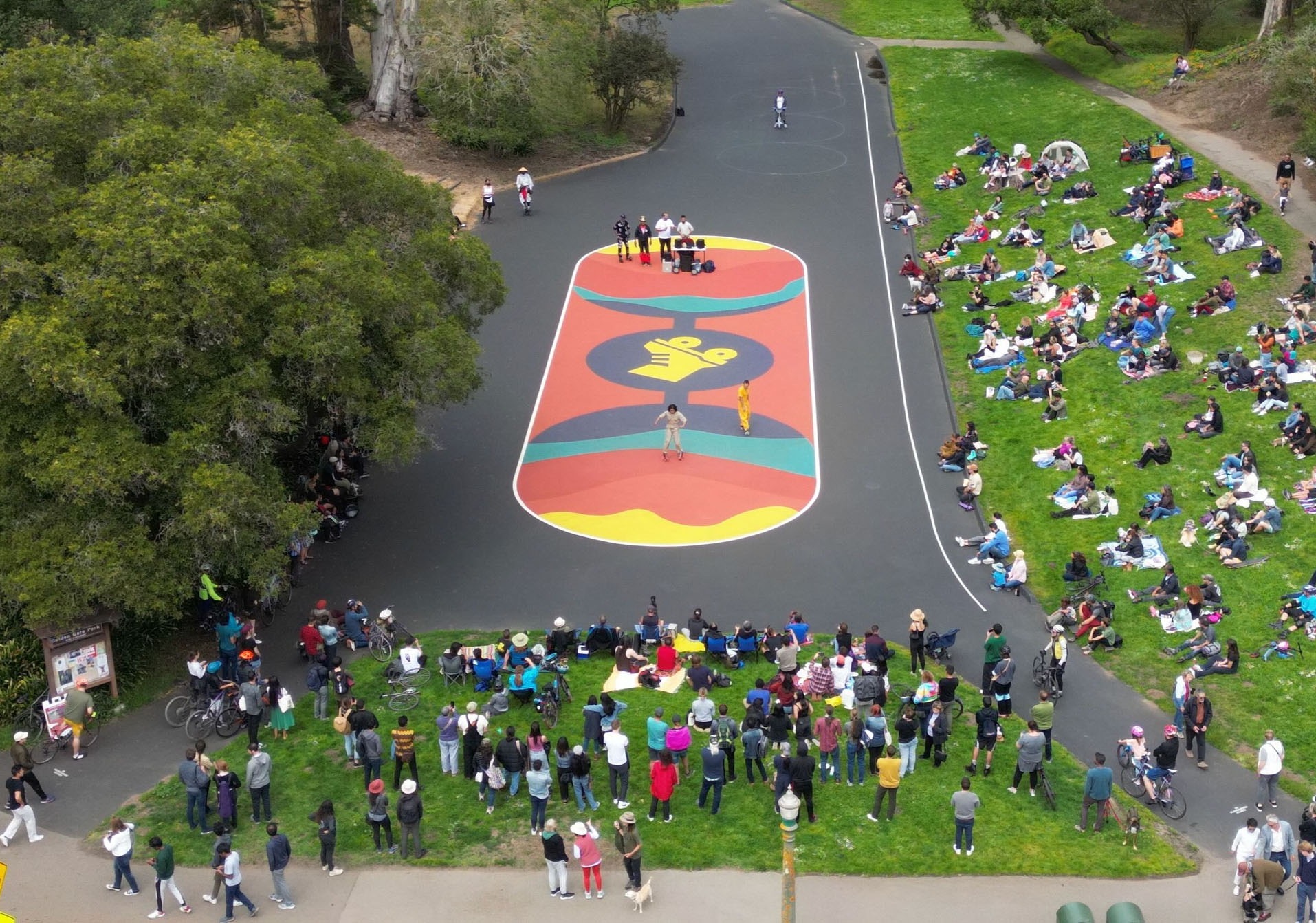
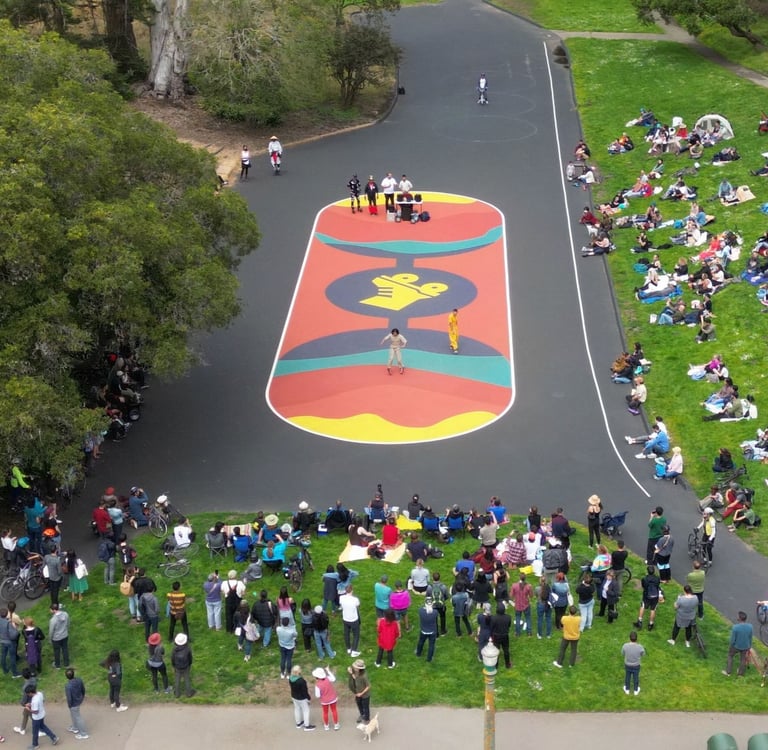
The Skatin' Place is a wide stretch of asphalt on JFK Drive, just inside the park at 6th Avenue, where San Francisco's roller skaters gather. On weekends — and especially Sunday afternoons — there are usually a dozen or so skaters circling, music coming from a portable speaker, more skaters arriving with bags and water bottles, beginners practicing on the edges. There is no rink fee, no equipment rental, no formal organization. People just show up.
Roller skating in Golden Gate Park goes back to 1891, when park superintendent John McLaren installed an outdoor rink near the Children's Playground. The current scene grew out of the roller-disco era — by the summer of 1979, an estimated 15,000 to 20,000 skaters were filling the park each Sunday — and survived a serious push in the early 1980s to ban skating in the park altogether. The local skater David Miles Jr. lobbied Rec & Park for a dedicated skating area, and Skatin' Place was the result: a $70,000 project that turned the stretch by 6th Avenue into the official outdoor home of roller skating in San Francisco.
In 2022, a 28-by-93-foot ground mural was painted directly onto the asphalt — a swirl of yellow, orange, red, teal, and purple around a central golden roller skate. The design, Psychedelic Golden Gate Skate, is the work of the Bay Area artist and skater Aimee Stevland. It's pretty to look at; it also serves a practical purpose, giving skaters a fixed visual reference to orient themselves as they circle. Skating goes counter-clockwise, rink-style.
If you're lucky, you might even spot Minnie the Skatin' Pup: a tiny white shih tzu who flies through the park on her human David's arm while he skates, her eyes half-closed in what can only be described as a Zen state.


Watch Minnie at the Skatin' Place (Youtube video)
Blue Heron Lake (formerly Stow Lake)
Located on Blue Heron Lake Drive


Blue Heron Lake is Golden Gate Park's largest body of water — a twelve-acre, doughnut-shaped lake that loops around Strawberry Hill, the wooded island at its center. Built in 1893, it was designed to serve three purposes at once: a place to row a boat, a scenic promenade for horse-drawn carriages, and a reservoir for irrigating the park.
The lake was called Stow Lake until 2024, after William W. Stow, a state assemblyman and park commissioner who helped raise the money to build it. Stow was also an outspoken antisemite who, from the Assembly floor, called for ridding California of its Jewish population and proposed taxing Jews to discourage them from opening businesses. After a community campaign to rename the lake, the San Francisco Recreation and Park Commission voted in January 2024 to do so — replacing Stow's name on the lake, on Stow Lake Drive, and on the Stow Lake Boathouse with that of the great blue herons that nest on Strawberry Hill each spring. The new name was the public's most-suggested in an open poll.
Strawberry Hill, named for the wild strawberries that once grew on its flanks, is the highest point in Golden Gate Park. Two bridges connect it to the shore: the Rustic Stone Bridge, built in 1893, and the Roman Bridge. Trails wind around the island and climb to the summit — a short, steep climb from the lakeshore — which once held Sweeney Observatory, a castle-like vista point built in 1891 and toppled by the 1906 earthquake. The trees are taller now, but glimpses of the city still open up between them. On the way up the hill, Huntington Falls — a 110-foot artificial waterfall funded by an 1894 gift of $25,000 from the railroad magnate Collis P. Huntington — cascades down toward the lake.
The lake and the hill are alive with wildlife. Ducks, coots, and turtles share the water year-round, and great blue herons arrive each spring to nest in the trees on Strawberry Hill.
Near the lakeshore stands the Golden Gate Pavilion, a brightly painted Chinese pagoda given to San Francisco by its sister city Taipei in 1976, assembled in Taiwan and reassembled on the shore.
Boating at the Lake
The Blue Heron Boathouse, at 50 Blue Heron Lake Drive on the lake's north shore, rents pedal boats and rowboats by the hour and has a snack bar. The current building, a chalet-style structure from 1946, replaced the original 1893 boathouse — designed by Arthur Page Brown, the architect of the San Francisco Ferry Building — which burned down in 1937. Boat rentals, hours, and the café menu are available at the Blue Heron Lake Boathouse site.
Blue Heron Lake and the Golden Gate Pavilion
Bison Paddock
1237 John F. Kennedy Drive

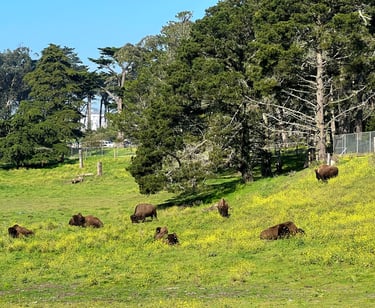
A herd of American bison has lived in Golden Gate Park since 1891 — longer, in fact, than most of the buildings around them have been standing. The first to arrive was a bull named Ben Harrison, after the president then in office, purchased for $350 from a Kansas conservationist who had begun his own breeding program in 1884. At the time the species had been hunted nearly to extinction; the bison Park Superintendent John McLaren brought to San Francisco were part of a national effort to save them. A female from Wyoming, Sarah Bernhardt, joined Ben Harrison the next year, and their first calf was born soon after.
The herd's first home was in the park's eastern end, near where the Music Concourse now stands. In 1899 they were moved to their current eleven-acre meadow alongside John F. Kennedy Drive. Over the next century, more than five hundred calves were born in the park — a contribution to the species' recovery that, alongside similar programs elsewhere, helped bring American bison back from the edge.
The bison in the paddock today are not descendants of Ben Harrison's line. The herd has been replaced more than once: most notably in 1984, when twelve new bison were given to then-mayor Dianne Feinstein by her husband Richard Blum as a birthday gift, and again in 2011 and 2020. The five youngest were added in March 2020 to mark the park's 150th anniversary. The whole herd is female now — adult bulls become aggressive in late summer, and the all-female arrangement keeps the paddock calm.
Calm is the word for the place. The bison spend most of their time grazing or resting, occasionally moving as a group to a different corner of the meadow. They can run thirty-five miles an hour and jump six feet from a standstill, but it is rare to see them do either. The paddock has a small viewing area along JFK Drive where visitors gather to watch — often surprised, almost always quiet, since the scale of the animals seems to ask for it.
Beach Chalet
1000 Great Highway


The Beach Chalet sits at the park's western edge, facing the Pacific across the Great Highway. Completed in 1925 as architect Willis Polk's final project, the Spanish Colonial Revival building first served as a lounge and bathing facility for Ocean Beach swimmers.
Its transformation came during the Great Depression, when the Works Progress Administration commissioned frescoes and mosaics for the ground floor. Lucien Labaudt, a French-born artist working for the WPA, painted real San Franciscans of the 1930s at work and play throughout the city — beach scenes, dock workers, and picnickers. The elaborate wood carvings along the staircase, featuring octopuses, sea maidens, and fish, were added in the same period.
The building served as Army coastal defense headquarters during World War II and then fell into long neglect. It was restored and reopened to the public in 1996.
Today the ground floor houses the Golden Gate Park Visitor Center, a free walk-in space where anyone can see the Labaudt frescoes up close. Volunteers at the desk can offer context on the murals and the building.
Upstairs, the Beach Chalet restaurant has a dining room of floor-to-ceiling windows facing the Pacific — particularly striking at sunset — and serves American food and beer brewed on the premises.
Behind the main building, the Park Chalet offers a more casual setting: a high glass ceiling, a stone fireplace, and outdoor seating in a garden, with live music on some evenings. It doesn't have the ocean view of its upstairs neighbor, but the trade is a quieter atmosphere closer to the park itself.
The Windmills
at the West end of the park, near Ocean Beach

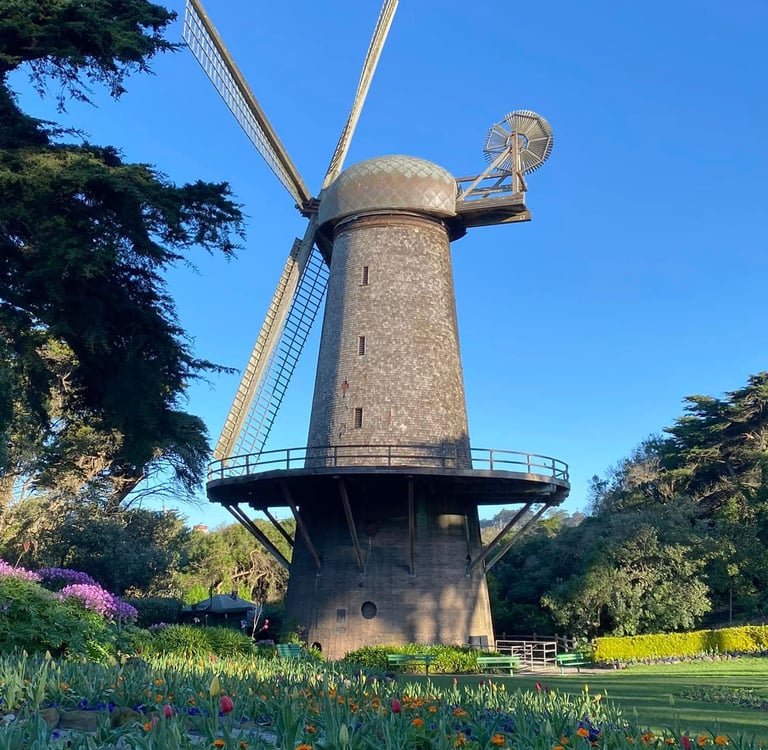
The two windmills at the western edge of Golden Gate Park were built for a purely practical reason: water. In the 1880s and 1890s, the park's western dunes had been transformed into a green expanse only at great expense, with the city paying the Spring Valley Water Company exorbitant rates to irrigate the new plantings. Park superintendent John McLaren, alarmed by the water bills, proposed pumping groundwater from beneath the dunes instead. The Park Commission authorized the first windmill in 1902.
The Dutch Windmill, at the park's northwest corner, was completed in 1903. It immediately began pumping up to twenty thousand gallons an hour — so much that it paid for its own construction within eighteen months. Its success made the case for a second, and in 1907 the San Francisco banker Samuel G. Murphy donated $20,000 toward a larger windmill at the southwest corner. The Murphy Windmill, completed in 1908, was said to be the largest windmill of its kind in the world. Together, the two pumped as much as 1.5 million gallons a day, supplying water to the lakes and irrigation systems of the entire western half of the park.
Their working lives were short. Electric pumps were installed alongside them as early as 1913, and by 1935 the windmills had been retired altogether. They sat unused for decades. During World War II some of their metal pumping parts were scrapped for the war effort, and by the 1950s both were in serious disrepair — their sails gone or rotting, pigeons and bats roosting inside, the structures listing toward collapse. Periodic proposals to demolish them were made and shelved.
Restoration came in two long campaigns. The Dutch Windmill was cosmetically restored in 1981, after a civic effort led by Eleanor Rossi Crabtree, daughter of a former San Francisco mayor. The Murphy took much longer. A group called the Campaign to Save the Golden Gate Park Windmills formed in 2000, raised funds for years, and in the 2000s had the entire cap — sixty-four tons of it — dismantled and shipped to the Netherlands to be reconditioned by the Dutch millwright Lucas Verbij. The restored cap was lifted back onto the tower in September 2011, and the sails were installed the following week. Both windmills are now functional again, though they spin only on special occasions or for maintenance.
Surrounded by tulip beds in the spring and visible from Ocean Beach across the Great Highway, the windmills are the park's western punctuation — the last landmarks before the Pacific.
This is an independent site about Golden Gate Park. For official information about the park, see the San Francisco Recreation and Parks website.
About · Getting There · Contact · © 2026 Golden Gate Park