Great Museums
Golden Gate Park has some of the best museums you'll find anywhere
California Academy of Sciences
55 Music Concourse Road

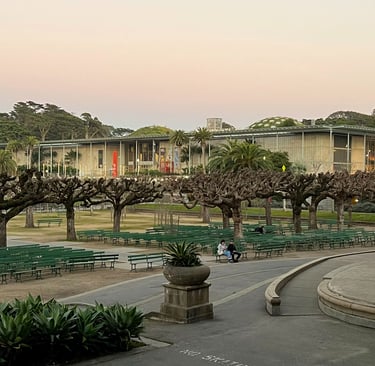
The California Academy of Sciences, founded in 1853, is the oldest scientific institution west of the Mississippi. For most of its history it occupied a sprawling cluster of buildings on this site in Golden Gate Park, accumulated piecemeal over the twentieth century. Then the 1989 Loma Prieta earthquake damaged the complex so severely that demolition became the only option. The Academy spent several years in temporary quarters downtown while planning what to build in its place.
The current building, designed by the Italian architect Renzo Piano and opened in 2008, is the result. Piano described his concept as lifting a piece of Golden Gate Park ten meters into the air and tucking the museum underneath. The 2.5-acre roof of native California plants undulates in a series of green hills that echo the city's topography. Beneath it, in a single connected space, are a four-story indoor rainforest enclosed in a glass dome, a planetarium under another dome, the Steinhart Aquarium with roughly 40,000 live animals, and a natural history museum. Three structures from the old Academy — African Hall, North American Hall, and the Steinhart Aquarium itself — were preserved and folded into the new building.
The architecture is also an exhibit. The living roof captures rainwater, regulates the building's temperature, and supports local wildlife including bees, birds, and butterflies. Skylights open and close automatically for ventilation, eliminating the need for air conditioning in most of the public spaces. A perimeter canopy holds 60,000 photovoltaic cells that supply a significant share of the building's electricity. The Academy was the largest public building to earn LEED Platinum certification when it opened.
Inside, the planetarium and the indoor rainforest are the experiences visitors talk about most. The rainforest is climbed via a spiraling ramp from floor to canopy, with butterflies released into the enclosed space; the planetarium runs immersive shows on a 75-foot dome. The aquarium downstairs holds Pacific coral reef tanks, a Philippine reef tank, and a colony of African penguins. The natural history galleries include exhibits on earthquakes (with a platform that simulates Loma Prieta), evolution, and California's regional ecosystems.
Visiting
The Academy is open daily, with general admission timed-entry tickets available at calacademy.org. On Thursday evenings, NightLife is an adults-only program with cocktails, music, and full access to the exhibits — a long-running favorite among locals. San Francisco residents can find reduced-admission and free-admission days through the Academy's website.
de Young Museum
50 Hagiwara Tea Garden Drive
The de Young is San Francisco's oldest art museum, founded in 1895 as an outgrowth of the 1894 California Midwinter International Exposition — the same world's fair that produced the Japanese Tea Garden across the way. Named for Michael H. de Young, co-founder of the San Francisco Chronicle, the museum grew through the early twentieth century into a Spanish Plateresque complex with a signature tower. The 1989 Loma Prieta earthquake damaged the buildings so badly that, after years of temporary bracing, the museum closed on the last day of 2000 and was demolished.
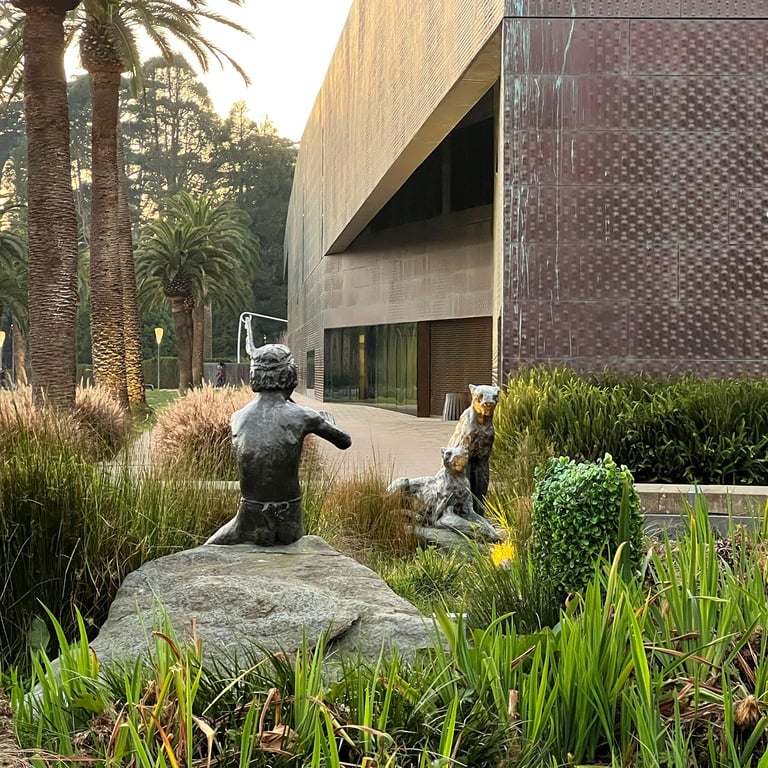
The current building, designed by the Swiss architects Herzog & de Meuron, opened in 2005. Its skin — roughly 950,000 pounds of copper, in some 7,600 perforated and dimpled panels — made it the largest copper-clad building in the world. The perforations, developed with the metal fabricator Zahner, were derived from photographs of the park's tree canopy viewed from below; from inside the museum, sunlight passing through them mottles the floors as if filtered through leaves. The architects intended the copper to oxidize gradually into a green patina that would echo the surrounding foliage. Two decades on, San Francisco's unusually clean coastal air has slowed that process considerably; the building is still browning, not yet green.
The most recognizable feature is the Hamon Observation Tower, a nine-story structure that twists slightly as it rises to align with the city's street grid at the top. The observation level, 144 feet up, offers 360-degree views — Ocean Beach to the west, the Marin Headlands and Golden Gate Bridge to the north, downtown to the east — and is free to enter, even without museum admission. The elevator to the top is just inside the main entrance, to the right of the admissions desk.
Inside, the de Young's permanent collection is strongest in American art from the seventeenth through twenty-first centuries, with deep holdings in painting, photography, sculpture, and decorative arts. The museum also holds significant collections of textiles and costumes, and of art from Africa, Oceania, and the Americas — the result of a 1972 reorganization in which the de Young's European holdings went to the Legion of Honor and it received the city's anthropological collections in exchange.
A few elements of the old de Young survived the demolition. The pair of sphinxes near the Pool of Enchantment, and the original palm trees flanking the entrance, were retained. The rest of the building is new.
Visiting
Tickets and current exhibitions are at deyoung.famsf.org. The observation tower is free; access to the galleries requires admission, with reduced and free options for San Francisco residents and on certain days each month.
Looking past the Pool of Enchantment at the De Young museum. Visible are two bronze sculptures by M. Earl Cummings: an Indian boy playing a musical pipe and two attentive California mountain lions.


The Conservatory of Flowers is the oldest building in Golden Gate Park, and the oldest wood-and-glass conservatory in North America. It also arrived in the park by accident. The 12,000-square-foot prefabricated greenhouse — manufactured on the East Coast and shipped around Cape Horn — had been ordered by the Gilded Age financier James Lick for his private estate in San Jose. Lick died in 1876 before it could be assembled. A group of San Francisco businessmen bought the unopened crates from his estate, donated them to the city, and the Conservatory was erected in Golden Gate Park on a site that had been set aside for exactly such a building in the park's original 1872 master plan. It opened in 1879.
The structure that resulted is a Victorian extravagance: a central glass dome fifty-seven feet square and sixty-eight feet high, flanked by two wings, the whole thing assembled from local old-growth redwood and thousands of panes of glass. Its survival has been improbable. It was rebuilt after a fire in 1883, came through the 1906 earthquake with only minor damage, and was closed for years in the 1930s due to structural instability. In December 1995 a freak windstorm — gusts measured at over a hundred miles an hour — shattered hundreds of panes and damaged the building so severely that it was closed for nearly eight years. The 2003 restoration, costing around $25 million, dismantled the structure piece by piece, replaced rotted wood with reclaimed redwood, rebuilt the metalwork, and put it all back together.
Inside are five galleries, each with its own climate. The Aquatic Plants gallery holds the giant Victoria water lilies whose pad-like leaves can grow several feet across — the same species that drew crowds to the Conservatory in its earliest years. The Highland Tropics gallery, kept cool and misty to mimic cloud forests, displays orchids and pitcher plants. The Lowland Tropics gallery is warmer and denser, home to a century-old Imperial philodendron and other long-residence specimens. The Potted Plants gallery preserves a Victorian sensibility, with seasonal displays of flowering plants in pots. And the Special Exhibits gallery rotates through themed shows.
The Corpse Flower
Every few years, the Conservatory's Amorphophallus titanum blooms — an enormous tropical plant that produces, for a day or two at a time, a flower as tall as a person and a smell often compared to rotting meat. When a bloom is imminent, the Conservatory typically extends its hours and announces it on social media. Lines form down the path.
Visiting
Tickets and current hours are at conservatoryofflowers.org. San Francisco residents can find free-admission days through the same site.
In the evenings, the Conservatory's glass exterior becomes a screen for Photosynthesis, a free nightly light show projected onto the building starting about 30 minutes after sunset; each cycle runs roughly half an hour and repeats until midnight. Viewers gather on the lawn out front. The Conservatory is closed during the show, but the show itself is the draw.
Conservatory of Flowers
100 John F. Kennedy Drive
Image courtesy of Frank Minjarez
This is an independent site about Golden Gate Park. For official information about the park, see the San Francisco Recreation and Parks website.
About · Getting There · Contact · © 2026 Golden Gate Park