Special Gardens
Six gardens within the garden.
Rose Garden
John F. Kennedy Drive and 14th Avenue
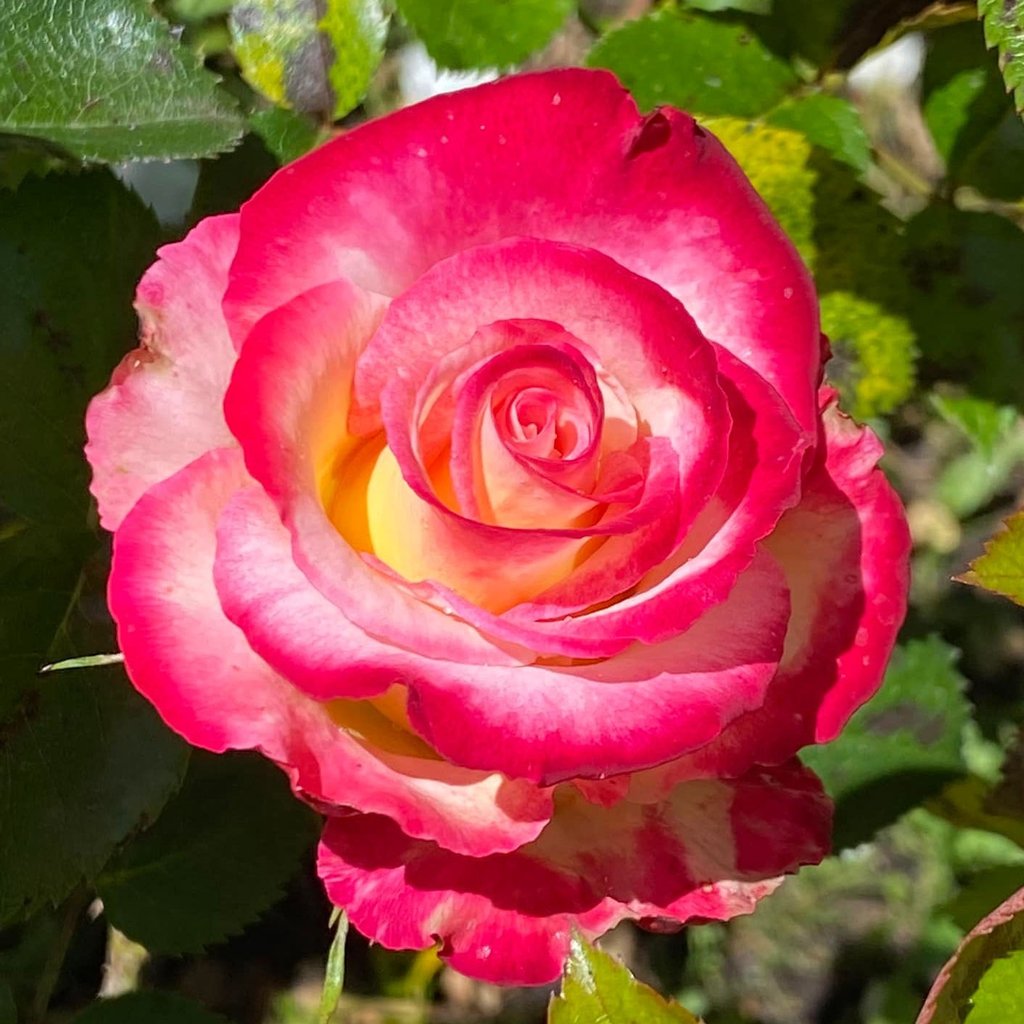
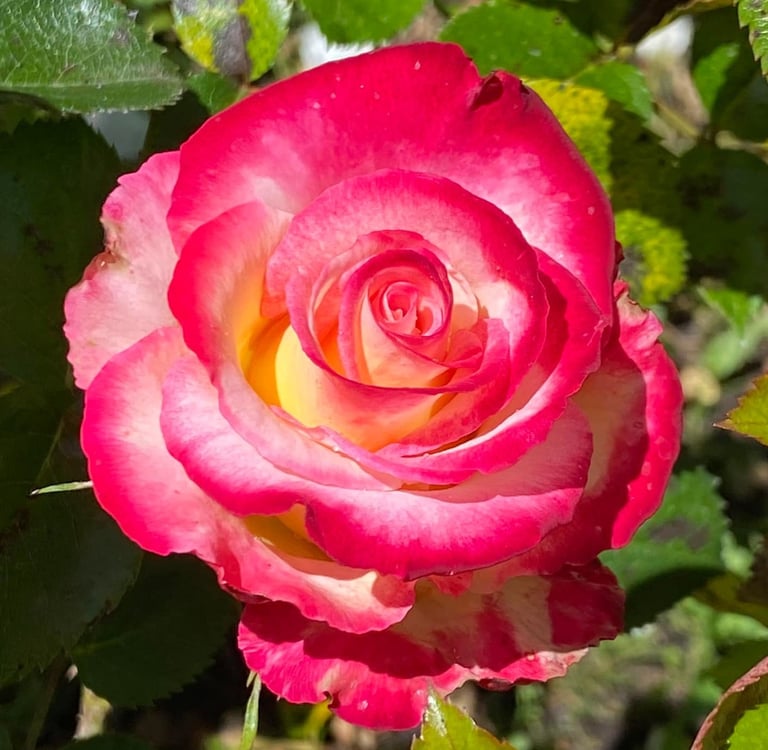
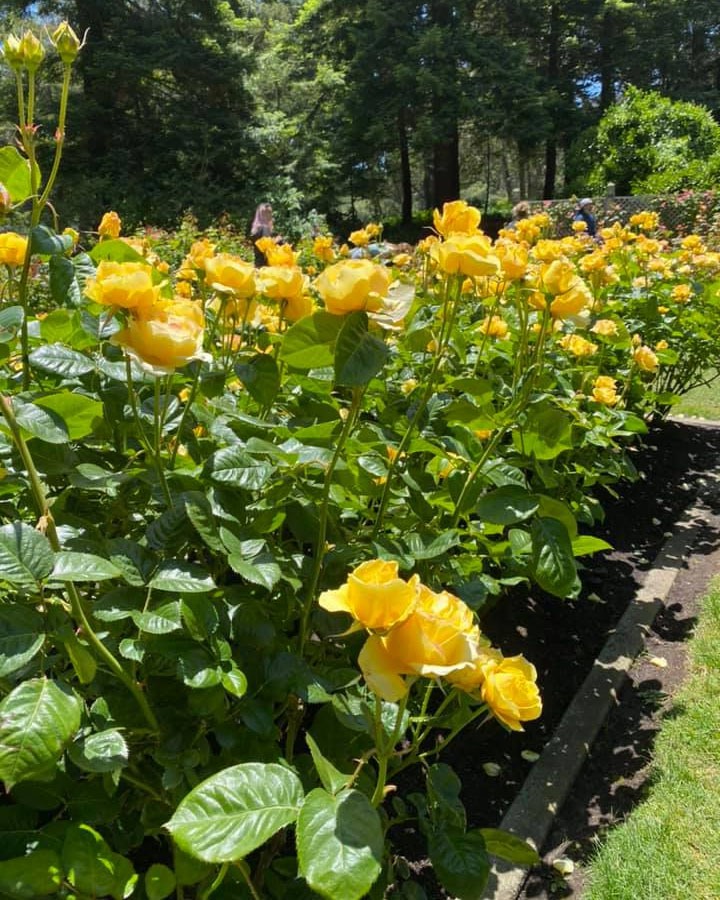
Golden Gate Park went without a municipal rose garden for nearly a century — partly because, in the early twentieth century, the conventional wisdom was that roses couldn't be grown in San Francisco. The sandy soil, foggy summers, and steady ocean winds were said to be wrong for them. Nursery employees actively discouraged customers from trying.
The San Francisco Rose Society set out to prove this wrong. Its first meeting was held on December 7, 1941 — the same day as the attack on Pearl Harbor — at the home of a Sunset District grower named George McDonough, who was reputedly producing roses "the likes of which had never been seen hereabouts." The society pushed for two decades for a public garden in Golden Gate Park, partnering eventually with the American Rose Society's San Francisco chapter, which wanted a cool-climate testing site for trial varieties. The garden was finally designed by Assistant Parks Superintendent Roy Hudson and dedicated on January 8, 1961.
Today the garden's roughly two acres hold 64 rose beds, most planted with a dozen plants of a single variety. The collection runs to hybrid teas, floribundas, grandifloras, miniatures, climbers, and a small selection of old-fashioned roses, and the great majority of the plants are donations from commercial growers and private donors. Each variety is labeled.
The bloom is at its peak from mid-May through June, with reduced flushes through summer and into fall. A few hardy climbers — "Golden Showers," "Joseph's Coat," "Altissimo," "Royal Sunset" — sometimes carry color into December.
Weddings at the Rose Garden
The Rose Garden can be reserved for weddings up to one year in advance. Maximum capacity is 150. Hourly rental fees are waived for veterans who are San Francisco residents, though other fees may apply. A lottery is held for popular dates. Details and the reservation page are at the San Francisco Recreation & Parks Department site.
Japanese Tea Garden
75 Hagiwara Tea Garden Drive
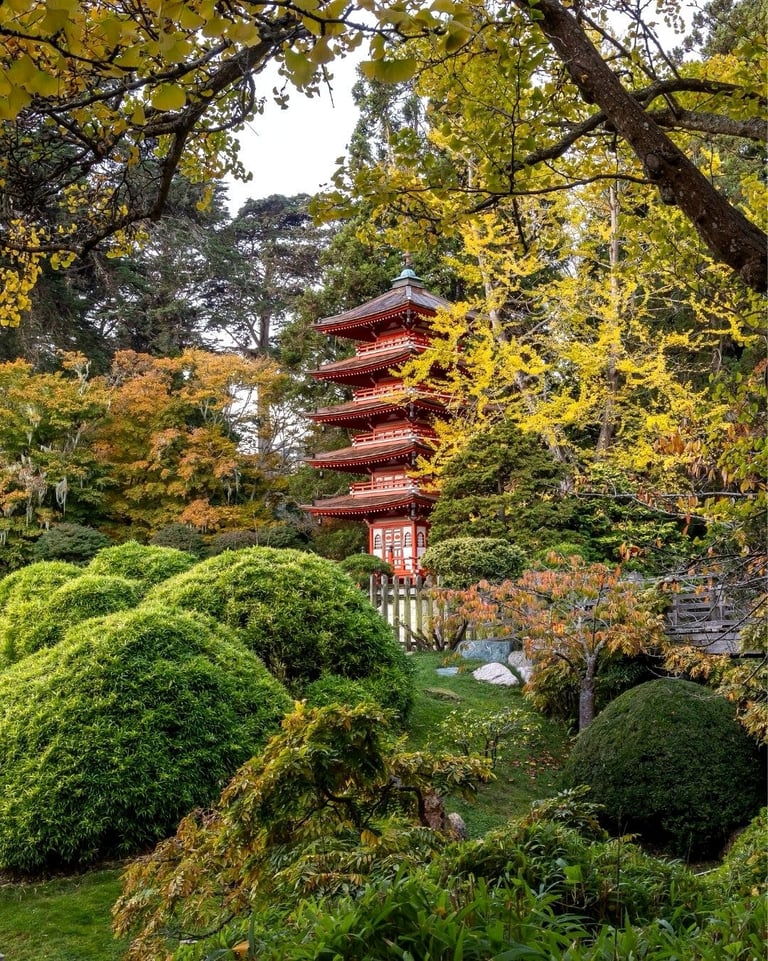
The Japanese Tea Garden began as a one-acre "Japanese Village" exhibit for the 1894 California Midwinter International Exposition, the world's fair that left Golden Gate Park much of its eastern end. When the fair closed, Makoto Hagiwara — a Japanese immigrant, landscape designer, and entrepreneur who had arrived in San Francisco in 1878 — reached a gentleman's agreement with park superintendent John McLaren: Hagiwara would design and maintain a permanent Japanese garden on the site, as a gift to the city.
What followed was a four-decade act of devotion. Hagiwara expanded the garden from one acre to five, paying for much of the work out of his own pocket. He imported plants, stone lanterns, koi, birds, and sculpture from Japan, built a seventeen-room home in the garden for his family, and is widely credited with serving the first fortune cookies in America at the garden's tea house. After his death in 1925, his daughter, her husband, and their three children continued the work.
Then, in 1942, came the rupture. Following Executive Order 9066, the Hagiwaras — along with some 120,000 other Japanese Americans on the West Coast — were forcibly removed and sent to internment camps, first to Tanforan in San Bruno and then to Topaz in Utah. The garden was renamed the "Oriental Tea Garden." The family's seventeen-room home was demolished and replaced with a European-style sunken garden. Many of the Hagiwaras' carefully assembled treasures were removed, and when the war ended, the family was barred from returning. The columnist Herb Caen wrote about their treatment in the late 1940s, and in 1952 the San Francisco Recreation and Park Commission voted to restore the garden's original name. In 1983 the city presented surviving family members with reparations — modest checks of $5,000 each — as part of a program for Japanese American city workers who had been fired during the war.
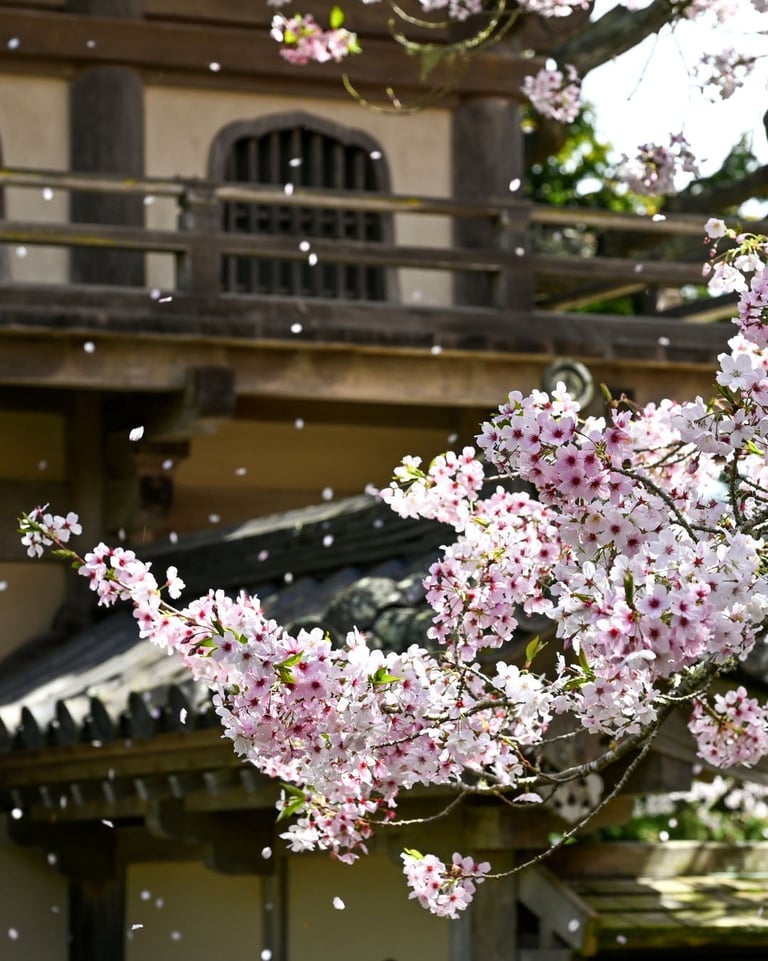
Today the garden's five acres hold the features Hagiwara assembled and that those who followed him have tended: stepping stones across koi-filled ponds, the steep arc of the drum bridge, a Zen garden of raked sand, a five-story pagoda originally brought from the 1915 Panama-Pacific International Exposition, and a working tea house. The garden changes dramatically with the seasons — cherry blossoms in early spring, irises and wisteria in May, deep reds and golds in autumn — and rewards return visits. The Hagiwara family's contribution is now acknowledged in the name of the drive that leads to the entrance.
Visiting
The Japanese Tea Garden is open six days a week. It is closed Wednesdays. It is open from 10:00 am to 4:30 pm, with the last entry at 4:00 pm. There is an enjoyable light art installation, Photosynthesis, beginning 30 minutes after sunset every night. The show is free to the public and is about 30 minutes long.
San Francisco Botanical Garden
1199 Ninth Avenue
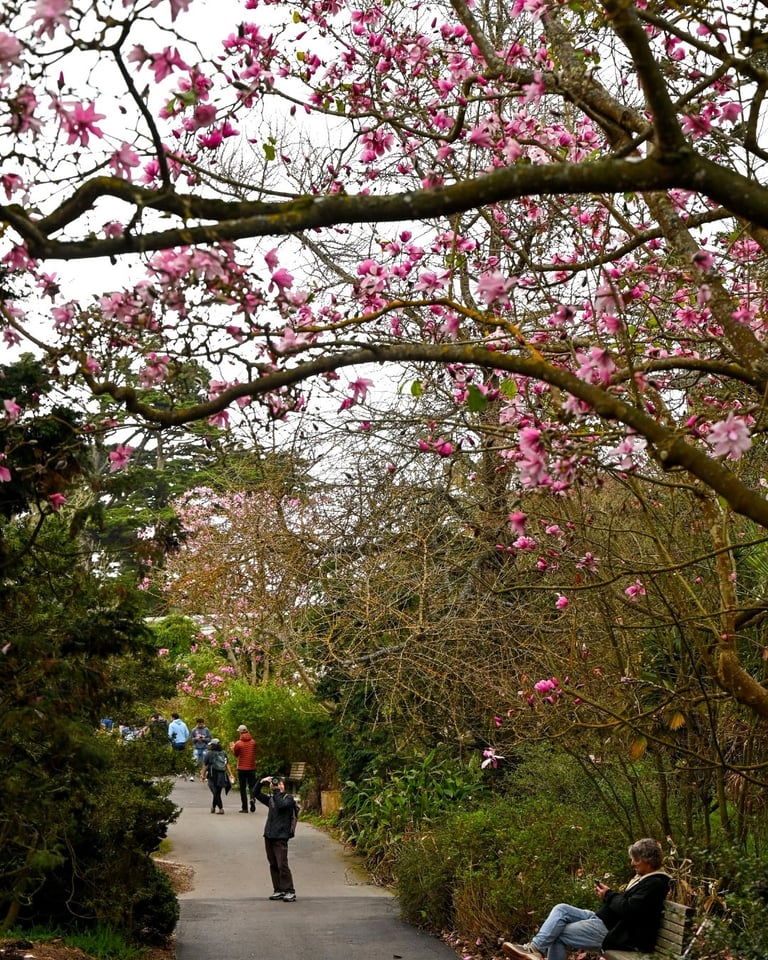
The San Francisco Botanical Garden — formerly Strybing Arboretum, and still often called that — occupies 55 acres on the south side of the park. It holds roughly 9,000 different kinds of plants, drawn from regions around the world that share San Francisco's unusual climate: cool, dry summers, mild winters, and steady coastal fog. That climate is the garden's central premise. Plants from the cloud forests of Central and South America, the highlands of Southeast Asia, the Mediterranean basin, South Africa, Australia, and Chile thrive here in ways they couldn't elsewhere in North America.
The idea for a botanical garden in this spot goes back to the 1880s, when park superintendent John McLaren first proposed one. Funding was never enough. In 1900, San Francisco voters rejected a bond measure for it outright. The garden finally got its money in 1926, when a widow named Helene Strybing left a substantial bequest in memory of her late husband. Planting began in 1937 with WPA labor and local donations, and the arboretum opened in May 1940 with about 2,000 specimens on eight acres. Eric Walther, McLaren's appointee, was the founding director and held the position for twenty years.
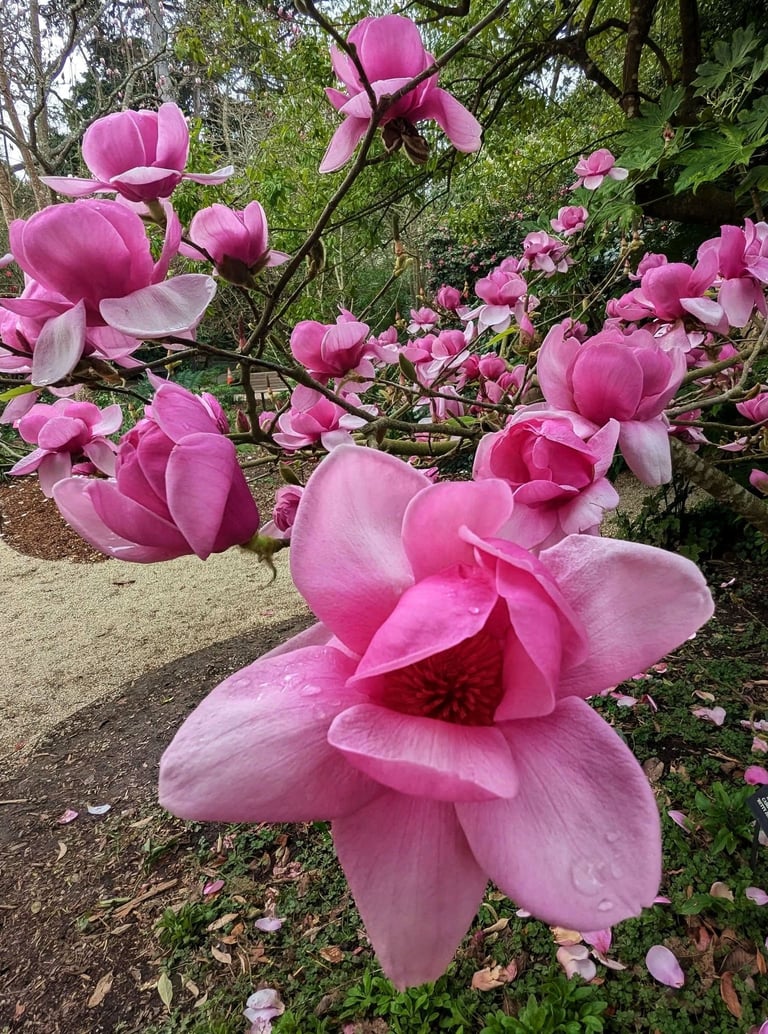
The garden is organized into specialized collections, each occupying its own section of the grounds: a Redwood Grove, a California Native Garden, gardens for plants from Chile, South Africa, Australia, and the Mediterranean, an Ancient Plant Garden of species that predate flowering plants, a Succulent Garden, a Children's Garden, a Garden of Fragrance, and a Moon-Viewing Garden overlooking a small island. The Magnolia collection is one of the world's most significant, with trees that bloom dramatically in February and draw photographers from across the region. The two cloud-forest gardens — one Mesoamerican, one Southeast Asian — are the only collections of their kind in any U.S. botanical garden.
Near the main entrance stands the Helen Crocker Russell Library of Horticulture, opened in 1972, with some 180,000 books, making it the largest horticultural library in Northern California. It's open to the public and free to use.
Visiting
The garden has a daily admission fee, but admission is free for San Francisco residents with proof of residency, for school groups, and on a few holidays each year (Thanksgiving, Christmas Day, and New Year's Day). Free 90-minute guided tours leave from the main gate daily. Hours, current admission prices, and event schedules — including the annual Flower Piano festival, when pianos are placed throughout the garden for visitors to play — are at the Gardens of Golden Gate Park site.
Dahlia Dell
Conservatory Drive East off of JFK Drive (next to the Conservatory of Flowers)
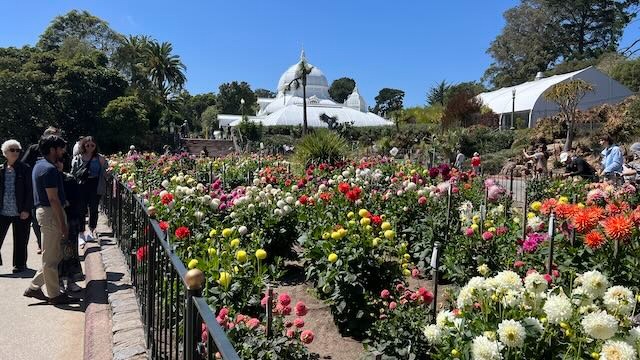
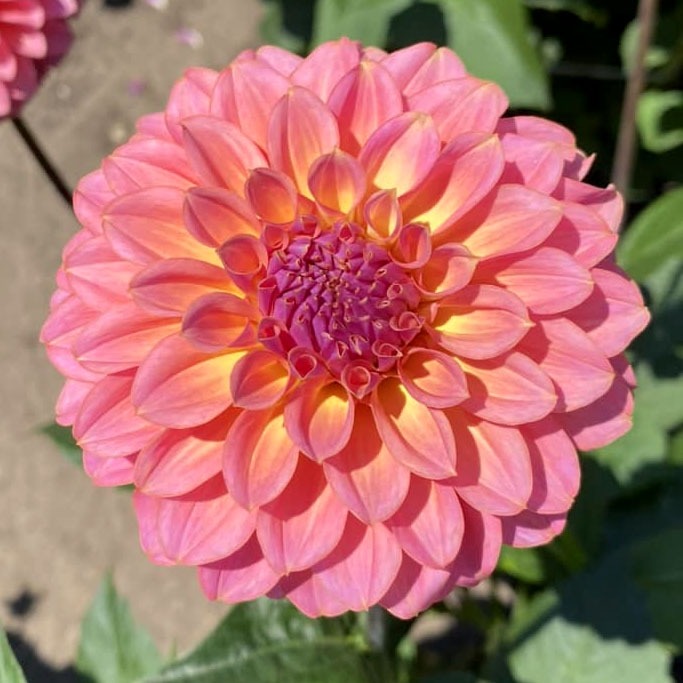
The Dahlia Dell is a small free garden, tucked into a triangular bed along the driveway loop east of the Conservatory of Flowers, that holds more than 700 named varieties of dahlias. From the tiniest pom (under two inches across) to the biggest dinnerplate (over twelve), the colors and forms are improbable — and almost all of it is the work of volunteers.
Dahlias have been grown in Golden Gate Park for over 100 years, and on October 4, 1926 the San Francisco Board of Supervisors adopted the dahlia as the city's official flower, calling it "the very symbol of San Francisco life and of the spirit of her people." The cool foggy summers that frustrate gardeners in other parts of the country happen to be exactly what dahlias need.
The Dell itself is maintained by the Dahlia Society of California — San Francisco's dahlia society, organized in 1917, and one of the oldest in the country. The Society pays for the tubers, the irrigation equipment, the fencing, and the soil amendments; the city provides the water. The actual labor — planting in spring, deadheading and disbudding through the summer, digging out the tubers each fall — is done by volunteers.
Bloom typically begins in June and continues into October, with the absolute peak in late August and early September. The Society's annual two-day Dahlia Show is held each August at the Hall of Flowers (the County Fair Building at the corner of Ninth and Lincoln), and tuber and plant sales are held there in the spring.
Kathleen's Garden (also known as Kathleen's Corner)
Corner of Fulton Street and Stanyan Street
At the corner of Fulton and Stanyan, just inside one of Golden Gate Park's busiest entrances, sits a small triangular island ringed with cobblestones. For more than four decades, Kathleen Russell tended it. She lived in the apartment building across the street and passed through the corner several times a day walking her dogs — first Love, then Poppy, then a scruffy terrier named Gracie. At some point she decided to adopt the corner. She pulled the weeds, hauled a hose from home, planted Icelandic poppies and a Princess tree that bloomed big purple flowers, and kept replanting whenever the garden was vandalized. In 2014, San Francisco Beautiful gave her an Unsung Hero award, noting that "it isn't just her garden that's beautiful" — Russell greeted everyone she met at the corner, tourists and neighbors and people in need, with the same warmth.
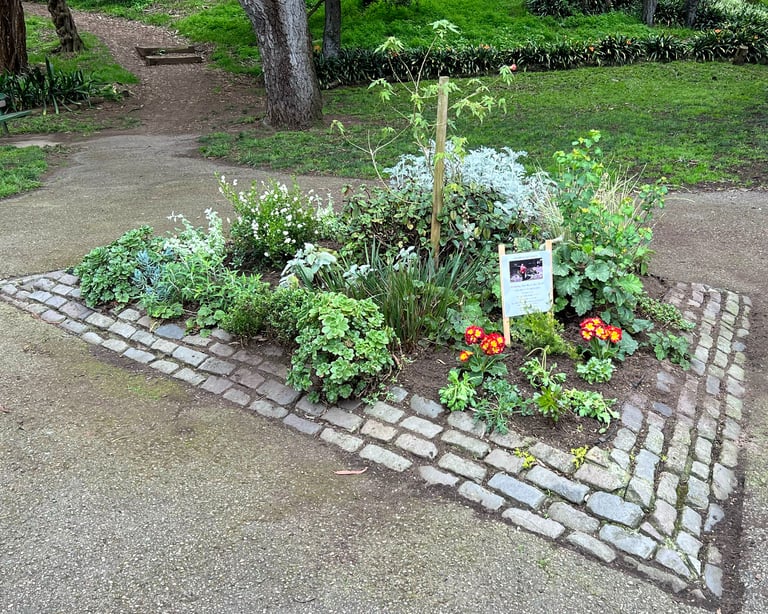
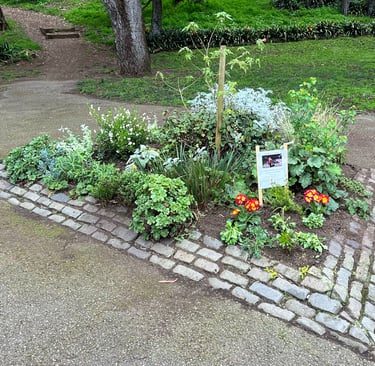
After Kathleen's passing in 2018 at age 86, some of her friends decided to carry on her work, forming a volunteer group that has since expanded the garden along Stanyan Street with native California plants including salvia, buckwheat, evening primrose, and red flowering currant. The group meets the first Saturday of each month from 10am to noon, and all are welcome to join. A dedicated park bench with a plaque reading "She shared beauty and kindness with all who entered here" honors Kathleen's memory and has become a stop on geocaching scavenger hunts. On workdays the volunteers wear a kind of uniform: grey T-shirts with a purple Princess tree blossom on the front and Kathleen's Garden Volunteer in script on the back, designed for the group by a neighbor.
The corner has drawn a small community of writers and visitors over the years. For a longer account of Kathleen's Garden and the volunteers who tend it, see Susan Freinkel's "Unofficial Stewards" on 1,017 Acres: Life in the Park.
AIDS Memorial Grove
Bowling Green Drive and Middle Drive East, near the tennis courts
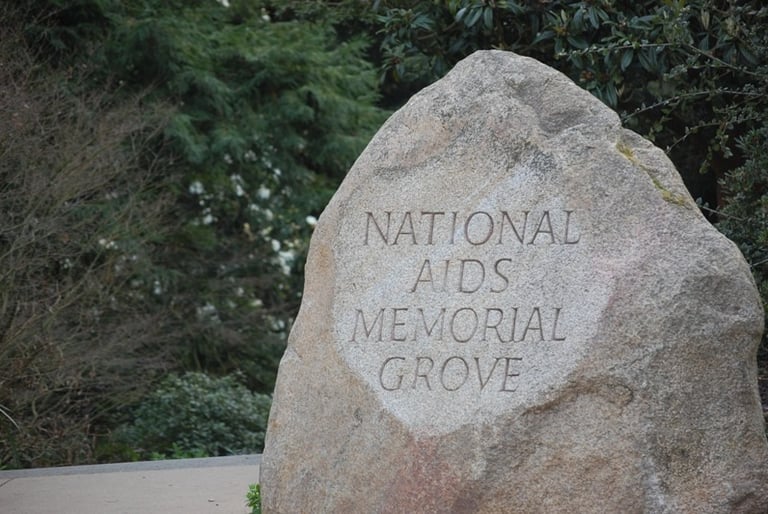
In the southeast corner of Golden Gate Park, in a wooded ten-acre dell among redwoods, rhododendrons, and ferns, sits the National AIDS Memorial Grove. It is the only federally designated AIDS memorial in the United States, a status it shares with the Vietnam Veterans Memorial and the USS Arizona at Pearl Harbor.
The Grove began in 1988, at the height of the AIDS epidemic, when a small group of San Franciscans — landscape designers and urban-environmental volunteers, most of whom had lost friends to the disease — set out to create a place to grieve. Founding member Alice Russell-Shapiro later described it as a time "when people would lose everyone in their address books." They chose the de Laveaga Dell, then an overgrown and dangerous ravine on the park's edge, and consulted with the landscape architect Garrett Eckbo on a design. Site work began in September 1991, and the volunteer workdays that started then have continued ever since. By recent counts, volunteers have given more than 225,000 hours to the Grove's care.
In 1996, legislation championed by Representative Nancy Pelosi and Senator Dianne Feinstein was signed into law by President Bill Clinton, designating the site the National AIDS Memorial Grove.
The Grove's central features unfold along a gentle east-to-west walk. Near the eastern entrance lies the Circle of Friends, a circular stone plaza inscribed with thousands of names — those lost to AIDS, and those who loved them. A path leads down through a sunny meadow and up the other side, past the Fern Grotto and the Circle of Peace to the western entrance. Throughout, boulders and benches carry more names and inscriptions.
Volunteering at the Grove
Workdays are held on the third Saturday of most months and are open to anyone — no experience needed, with tools, gloves, and instruction provided. For the current schedule and other events including the annual World AIDS Day observance on December 1, visit the National AIDS Memorial website.