More To Explore
Lots more to see in Golden Gate Park...
Music Concourse
Music Concourse Drive off of MLK Drive

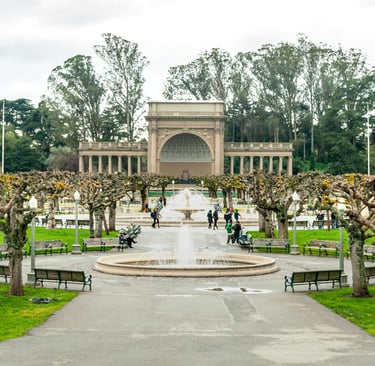
The Music Concourse is the sunken oval plaza between the de Young Museum and the California Academy of Sciences, and the cultural heart of the park's eastern half. It was built in 1893 as the Grand Court of Honor for the 1894 California Midwinter International Exposition — the same fair that produced the Japanese Tea Garden across the way and the de Young itself. After the fair, park superintendent John McLaren reshaped the space into a public music venue, with terraced seating, pedestrian tunnels, and an outer carriage drive. The depressed elevation, intentional from the start, shelters audiences from the summer winds.
Anchoring the concourse at its western end is the Spreckels Temple of Music, a classical Beaux-Arts bandshell dedicated in 1900. It was a $75,000 gift from the sugar magnate Claus Spreckels, designed by the Reid Brothers (the firm behind the Fairmont Hotel) and built of Colusa sandstone. The structure has weathered both the 1906 and 1989 earthquakes; the most recent restoration was completed in 1996. The Golden Gate Park Band — founded in 1882, and one of the oldest professional concert bands in the United States — has been performing free Sunday concerts here since the bandshell opened. The season runs from April through October, typically beginning at 1 p.m. Schedules are at goldengateparkband.org.
The concourse itself is shaded by the pollarded London plane trees and Wych elms that give it its distinctive sculpted look — branches pruned hard each winter, leafing out in spring into the rounded canopy you see most of the year. Scattered through the plaza are statues and monuments donated over the decades.
Image courtesy of David Vives
Portals of the Past
At Lloyd Lake, off John F. Kennedy Drive
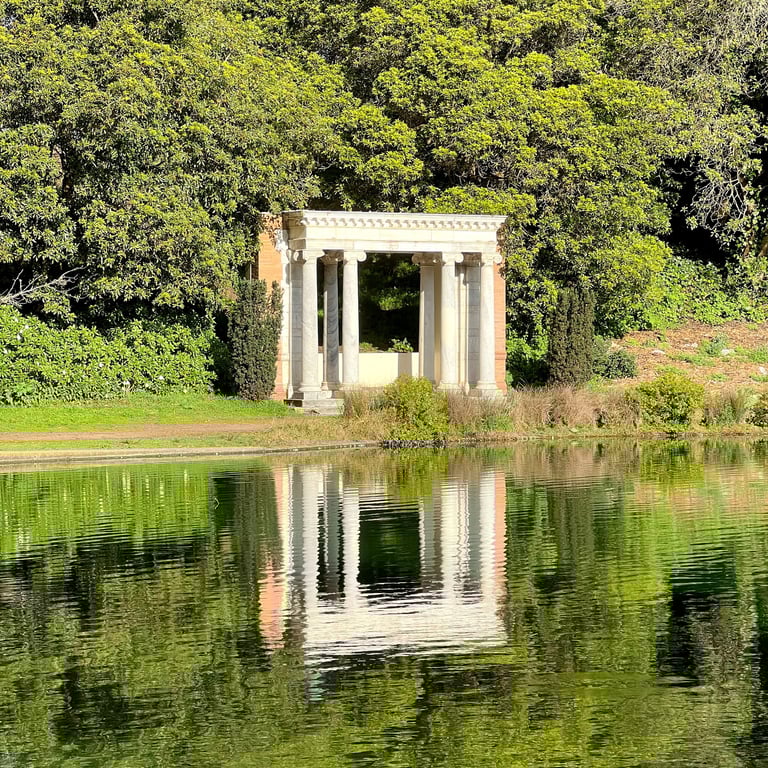
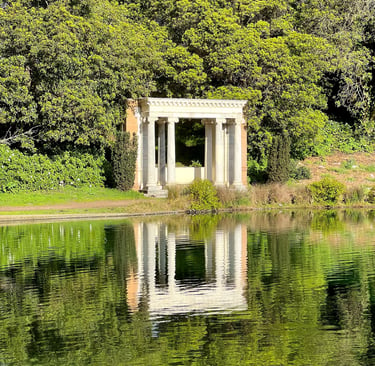
A white marble portico — six columns supporting a Greek-revival entablature — stands on the north shore of Lloyd Lake, reflected in the water. It was once the front entrance of a Nob Hill mansion. It is, in fact, almost all that's left of it.
The house belonged to Alban N. Towne, vice president and general manager of the Southern Pacific Railroad. Built in 1891 at the corner of California and Taylor streets, it stood until April 18, 1906. When the earthquake struck and the fires that followed swept Nob Hill, the mansion burned along with most of its neighbors. The marble portico was the only substantial fragment left standing.
Within days, the surviving portico became one of the most photographed objects in the ruined city. From the right angle, the empty doorway perfectly framed the smoldering shell of City Hall, far down the hill. Arnold Genthe and Willard Worden both made images of it that became iconic. The poet Charles Kellogg Field — later editor of Sunset magazine — coined the phrase that gave the structure its name: "This is the portal of the past — from now on, once more forward!"
Caroline Towne donated the portico to the city in memory of her husband, and in 1909 it was reassembled on the shore of Lloyd Lake in Golden Gate Park, where it has stood ever since. One of the original six marble columns crumbled in the 1957 earthquake and was replaced; a later restoration by the San Francisco Arts Commission stabilized the structure against future seismic damage and water intrusion.
From JFK Drive, the columns and their reflection make a single image, doubled.
Anglers Lodge
1232 John F. Kennedy Drive (across from the Bison Paddock)
Tucked behind a screen of eucalyptus on the north side of JFK Drive sits a rustic redwood-and-fieldstone lodge built by the Works Progress Administration in 1938. It's one of the small, perfect surviving works of the New Deal in San Francisco, and almost everything inside it — the wrought-iron hardware, the carved fish on the shutters, the hand-hewn window frames — was made by hand on site. A leaded-glass panel of a fishing fly, salvaged from the club's earlier clubhouse at Stow Lake (now Blue Heron Lake), hangs in one of the windows.
The lodge is home to the Golden Gate Angling and Casting Club, founded in 1933 as an offshoot of the still-older San Francisco Fly Casting Club (1894). With more than 1,300 members today, it is recognized as the largest fly-fishing club in the world. The WPA built the lodge and pools in exchange for the club's promise to teach fly casting to anyone who asked — a promise the club still honors. Free public casting clinics are held on the second Saturday of every month; beginners are welcome, and loaner rods are available.
Adjacent to the lodge are three concrete casting pools, connected in an open rectangle measuring roughly 450 feet by 185 feet. The water is clear; there are no fish (so no license is required); floating ring targets and lines on the pool bottom mark distances. Anyone is welcome to cast, free of charge, any day the gates are open. Members are often present and frequently happy to give tips.
The pools have hosted national casting tournaments since 1939 and the annual Spey-o-rama world championship each April. Their most famous recent product is Maxine McCormick, a local girl who learned to cast at these pools and, in 2016 at age twelve, won the women's world casting championship in Estonia — the youngest world champion in the sport's history.
The lodge itself is open to the public whenever a club member is present, and is worth stepping inside: a small library of fishing books and tapes, vintage rods, photographs, and club memorabilia line the walls of a single beautifully crafted room.


Koret Children's Quarter and Carousel
320 Bowling Green Drive
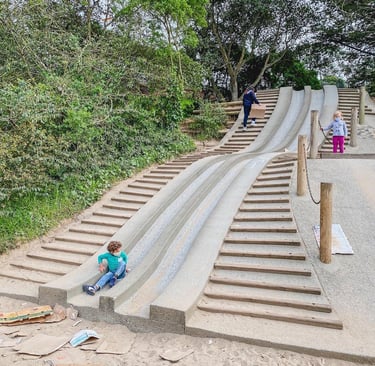
The playground at the park's southeast corner opened in 1888 as the Sharon Quarters for Children — built with a $50,000 bequest from the estate of Nevada senator William Sharon, who left money for the beautification of Golden Gate Park. It is widely thought to be the first public playground in the United States, though similar playgrounds were opening across the country in the same era as part of the Playground Movement. At a time when public space rarely made room for children's recreation, the Sharon Quarters was a genuinely new idea.
The original playground had swings, see-saws, goat-pulled carts, and, as the San Francisco Chronicle reported, "nice, gentle donkeys for nice, gentle children." There were separate areas for boys (a ballground) and girls (a croquet lawn); men and older boys were not permitted on the grounds.
The Sharon Building, a Victorian-Romanesque stone structure that has anchored the playground since 1888, was designed for indoor play on rainy days. The 1906 earthquake left it standing. Today it houses the Sharon Art Studio, which offers art classes for children and adults year-round.
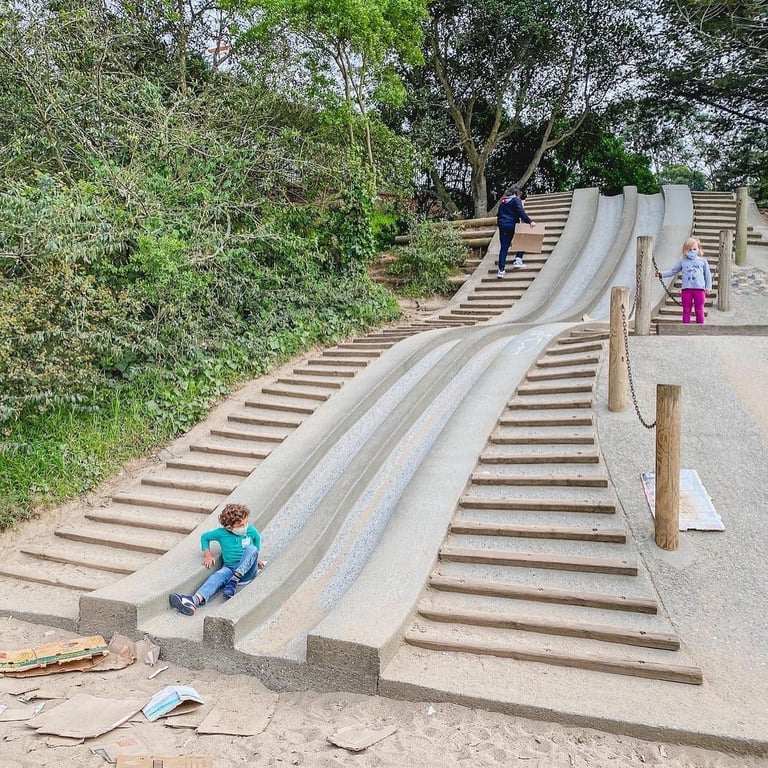
A major renovation funded by the Koret Foundation reopened the playground in 2007 as the Koret Children's Quarter. The historic concrete slides — set into a small hill, ridden traditionally on a piece of cardboard — were preserved. New features include a rope-climbing structure, swings, a wave-shaped climbing wall, a small barnyard, and large sand areas. The adjacent lawn is popular for picnics and birthday parties.
The Carousel
Just west of the playground stands a 1914 Herschell-Spillman menagerie carousel, the third carousel to occupy the site. (The first arrived shortly after the playground opened, steam-powered, with PG&E later loaning the park an electric motor.) The current carousel saw earlier service at amusement parks in Los Angeles and Portland and at the 1939 World's Fair on Treasure Island before being installed in Golden Gate Park in 1940. It was closed for restoration in 1977 and reopened in 1984 with all 62 of its hand-carved menagerie animals — horses, a dragon, a camel, a goat, frogs, dogs, roosters, ostriches, and pigs — newly painted. Bay Area landscapes are painted on the panels inside the cupola, and a German band organ provides the music.
Pricing can be found on the Rec and Park website. For current hours, call (415) 231-0077.
This is an independent site about Golden Gate Park. For official information about the park, see the San Francisco Recreation and Parks website.
About · Getting There · Contact · © 2026 Golden Gate Park